Golf Swing Low Back Pain: Why It Happens and What Helps
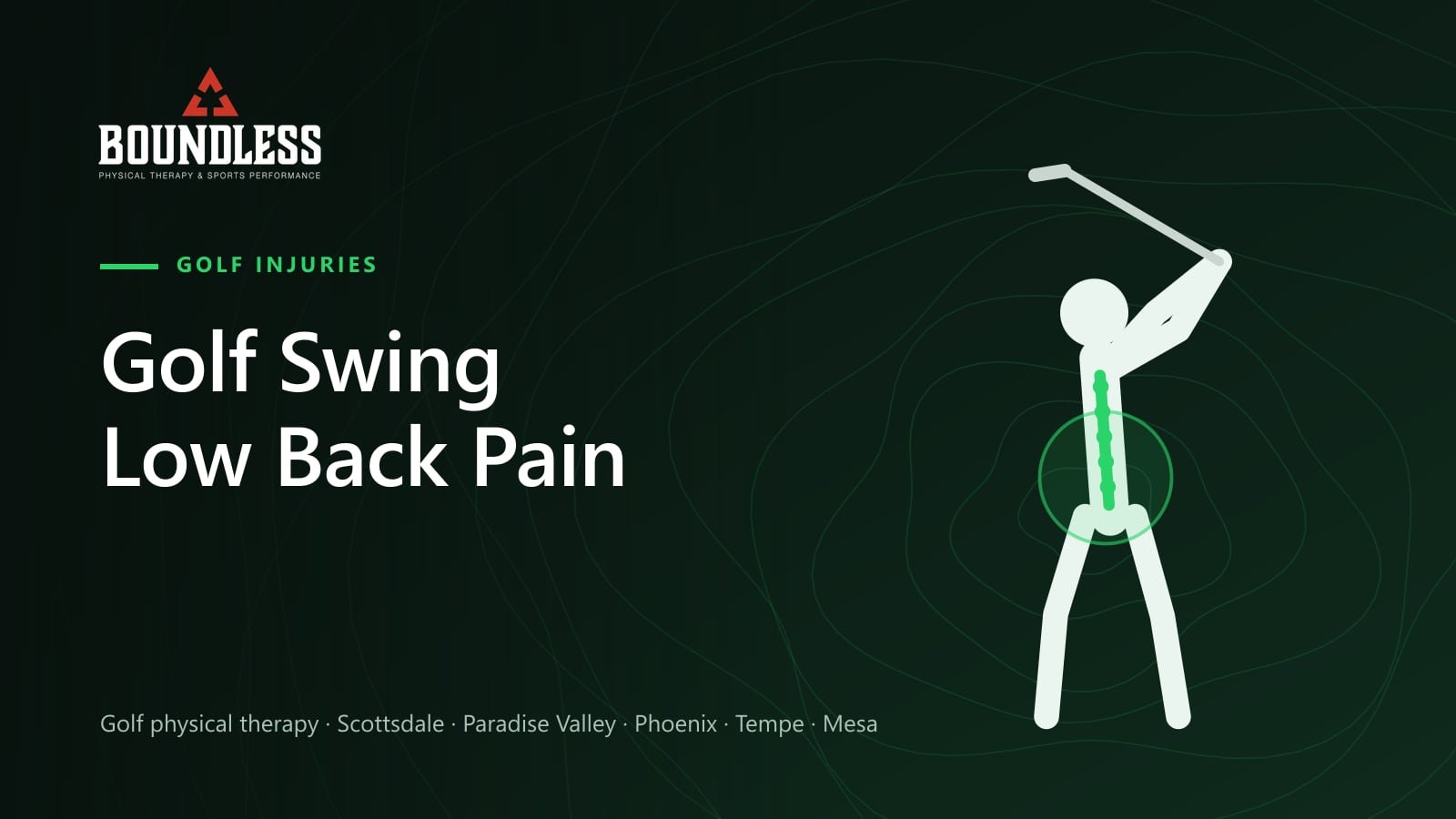
Low back pain is one of the most common complaints among golfers. For many players over 40, it starts as stiffness after a range session, turns into a dull ache by the back nine, and eventually makes you swing at 70 percent just to get through a round. The good news: in many cases, back pain from the golf swing is a mechanical problem with mechanical contributors, and those contributors can usually be assessed and addressed.
This article explains why the swing loads the lower back, how limited hip and upper back mobility shift stress onto the lumbar spine, when it makes sense to see a physical therapist, and what a golf-focused assessment actually looks like.
Why the golf swing loads the lower back
A full golf swing asks your body to rotate fast, under control, and then stop. In a matter of about a second, you coil away from the target, reverse direction, accelerate the club, and decelerate everything on the follow-through. The lower back sits right in the middle of that chain.
Here is the key detail: the lumbar spine is built more for stability than for rotation. Each lumbar segment only rotates a few degrees. Most of the turn in a healthy swing is meant to come from the hips below and the thoracic spine (upper and mid back) above. A review in the Global Spine Journal on golf and the lumbar spine makes the same point, noting that rehabilitation for golfers should focus on improving rotation through the thoracic cage and hips, since the lumbar spine itself rotates only a few degrees (Haddas et al., Global Spine Journal).
On top of rotation, the swing adds:
- Side bending and extension through impact, especially in a “reverse C” style finish or when a player hangs back on the trail side.
- Compression and shear as the trunk muscles fire hard to transfer force from the ground to the club.
- Repetition. A bucket of balls can mean 80 to 100 full swings, plus practice swings, often with little warm-up.
- Posture time. Bending over putts, chips and a golf bag adds up across four or five hours.
None of this means golf is bad for your back. Many people with back pain return to golf and play for decades. It means your back needs the rest of your body to do its share.
When the hips and upper back are stiff, the low back pays
If your hips cannot rotate well, or your upper back is stiff from years of desk work and driving, your body still tries to make the same shape at the top of the backswing. The motion has to come from somewhere, and the lumbar spine is often what gives.
Hip rotation
In a right-handed golfer, the trail (right) hip needs internal rotation to load into the backswing, and the lead (left) hip needs internal rotation to post up and rotate through impact. When either hip is limited, golfers often sway, slide, or rotate early through the lumbar spine. Some research has associated asymmetry in hip rotation with low back pain in golfers. We cover this in more detail, including a simple self-screen, in our article on hip mobility for the golf swing.
Thoracic rotation
The mid back is where a lot of your shoulder turn should come from. A rounded, stiff thoracic spine limits that turn, so golfers chase a full backswing by over-arching or over-twisting the lower back instead.
Other contributors worth checking
- Glute and core strength that cannot control rotation at speed
- Prior back injury (a history of back pain is one of the more consistent risk factors for future episodes)
- Sudden jumps in practice volume, like a golf trip or a new season
- Equipment and setup issues, such as clubs that force an overly bent or upright posture
It is worth being honest about the evidence. A 2018 systematic review and meta-analysis in Sports Health found that older age, higher body mass, and a prior history of back pain were associated with low back pain in golfers, and it did not find consistent evidence linking specific swing characteristics to pain (Smith et al., Sports Health). That is one reason a good assessment looks at the whole person, not just the swing on video.
A quick self-check you can do at home
These are not a diagnosis, just a way to notice where you might be stiff. Stop if anything causes sharp or worsening pain.
- Seated rotation: Sit tall on a chair, arms crossed on your chest, feet flat. Rotate your upper body each way without letting your hips move. Does one side feel noticeably shorter or tighter?
- Hip rotation on your back: Lie on your back with knees bent and feet wide. Let both knees fall slowly to one side, then the other. Compare how far they go and where you feel the stretch.
- Golf posture hold: Take your address posture with a club across your shoulders and hold it for 30 seconds. Does your back ache, or do you feel it in your hips and legs?
- Single-leg stand: Stand on each leg for 20 seconds. Wobbling a lot on one side can hint at hip control differences.
When to see a physical therapist (and when to see a doctor first)
Consider booking a physical therapy evaluation if:
- Your back pain keeps returning after rounds or practice sessions
- You have shortened your swing, skipped the driver, or stopped walking the course because of your back
- Pain has lasted more than a couple of weeks without clear improvement
- You want to get back to golf after a back flare-up with a plan instead of guesswork
See a physician promptly if back pain comes with numbness in the groin or inner thighs, new trouble controlling your bladder or bowels, progressive leg weakness, fever, unexplained weight loss, or pain after a significant fall or trauma. The American Physical Therapy Association lists loss of bowel or bladder control and groin numbness as reasons to go to the emergency department right away (ChoosePT, Physical Therapy Guide to Low Back Pain).
Arizona is a direct access state, so you do not need a physician referral to start physical therapy. A good physical therapist will also tell you when something is outside their scope and refer you on.
What a golf-focused PT assessment looks like
A general back evaluation and a golf-specific one overlap, but the golf version asks a different question: what does your swing need, and what is your body able to give it?
With Dr. Phil Yoon, a Doctor of Physical Therapy who is also a Certified Strength and Conditioning Specialist, a typical first visit includes:
- History: how and when the pain started, your playing and practice schedule, past injuries, and your goals (a pain-free 18 holes, more distance, a tournament, or simply walking the course again).
- Movement screen: hip and thoracic rotation, hip and core strength, balance, and how your back responds to bending, extension and rotation.
- Swing-related movement: your address posture and the positions that bother you, with a club in hand where it is safe to do so.
- A plan: hands-on treatment where appropriate, a short home program you will actually do, and guidance on practice volume while you recover.
Treatment may include manual therapy, mobility work for the hips and mid back, progressive strengthening, and, when it fits, dry needling (Phil is certified in dry needling). For more on the clinical side of back care, see Phil’s page on low back care on the main Boundless site. Recovery timelines vary from person to person, and the goal is steady, measurable progress rather than a quick fix.
Care that comes to you
Boundless Physical Therapy & Sports Performance is a mobile practice. Phil comes to your home, club, or gym across Scottsdale, Paradise Valley, Phoenix, Tempe and Mesa, and every session is one-on-one for the full visit. The practice is out-of-network, and superbills are available on request if you want to submit to your insurance. You can see the full list of golf physical therapy services and check the areas Phil covers.
Get back to swinging with confidence
If your lower back is shaping your swing, your schedule, or your enjoyment of the game, it is worth finding out why. Book a golf physical therapy evaluation and get a clear plan built around your body and your golf.