Hip Mobility for the Golf Swing: A Better, Safer Turn
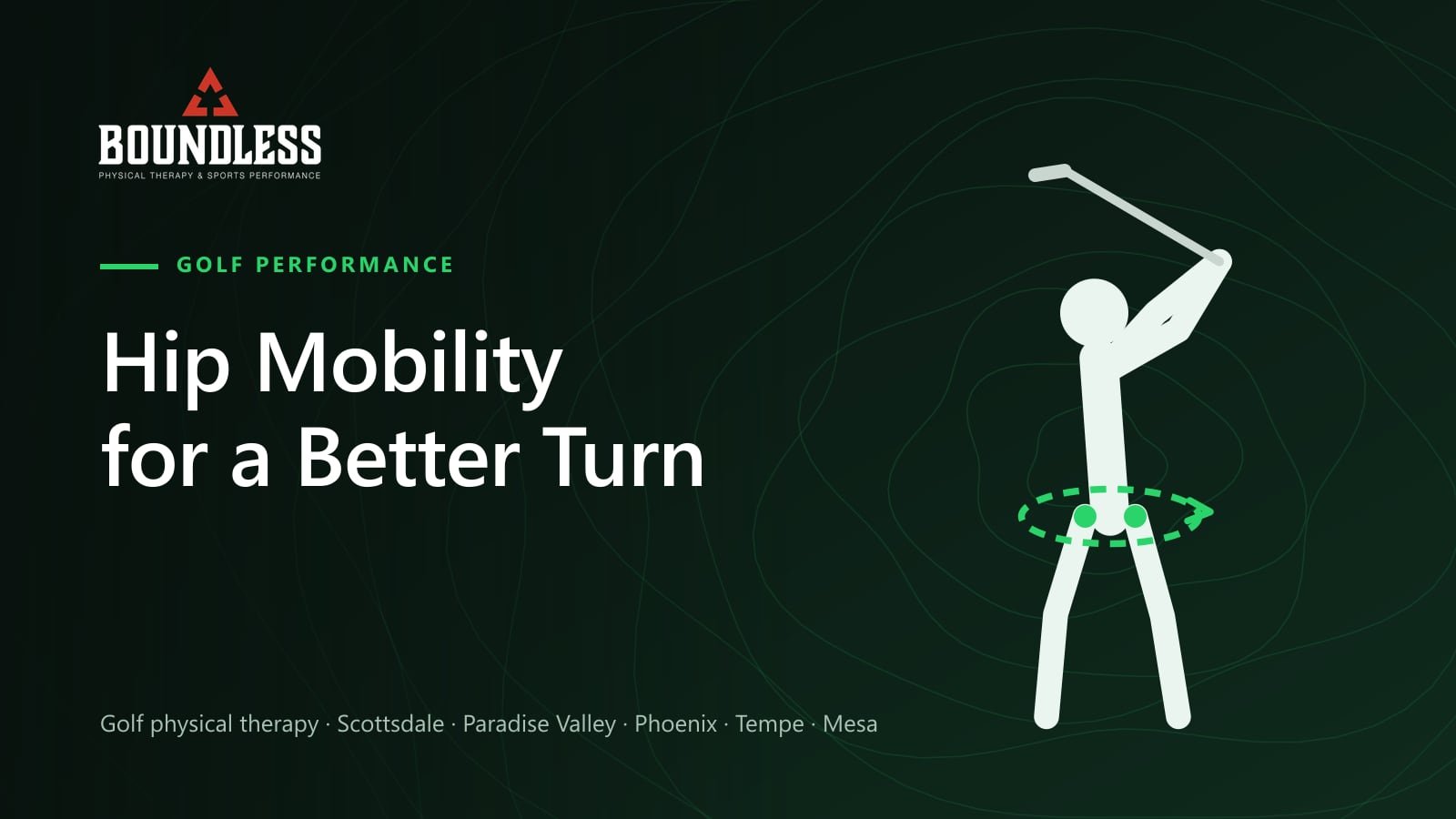
Ask golfers where their swing power comes from and most will point to their arms or shoulders. In reality, the hips are the engine room. They help you load into the backswing, start the downswing, and rotate through to a balanced finish. When they move well, the rest of the body tends to have an easier job. When they do not, the stress has to go somewhere, and it often lands on the lower back or knees.
This article explains what your hips need to do in the swing, gives you a simple self-screen you can try at home, and covers why limited hip mobility matters for both performance and comfort.
What the hips do in a golf swing
The examples below are for a right-handed golfer. Left-handed players can simply flip them.
Trail hip (right hip): loading the backswing
As you turn back, your pelvis rotates away from the target while your right leg stays relatively stable. That means the right thigh bone rotates inward relative to the pelvis. This is internal rotation of the trail hip. Good trail hip internal rotation lets you turn into your right side instead of swaying off the ball or straightening the right leg.
Lead hip (left hip): rotating through impact
In the downswing, your weight shifts toward the target and your pelvis rotates open. Now the left leg is the post you rotate around, which again calls for internal rotation, this time in the lead hip. Limited lead hip rotation is a common reason golfers slide past the ball, stall their rotation, or finish with the weight hanging back.
Both hips: extension and stability
Beyond rotation, the hips also need enough extension (moving the leg behind you) to finish tall, and enough glute strength to control rotation at speed. Long hours of sitting can make hip flexors feel tight and the glutes less active, which shows up as an early extension or a cramped finish.
Why stiff hips push stress to the back and knees
The swing is a chain. If one link does not move, the links above and below are asked to move more.
- Lower back: The lumbar spine is designed mainly for stability, and each segment rotates only a few degrees. A review on golf and the lumbar spine recommends improving rotation through the hips and thoracic spine to reduce the load on the lumbar spine, and it cites research linking asymmetry in hip internal rotation with low back pain in golfers (Haddas et al., Global Spine Journal). You can read more in our article on golf swing low back pain.
- Knees: When the hip cannot rotate, the knee often twists instead, especially the lead knee as you rotate through. Knees are built mostly to bend and straighten, so repeated rotational stress can be irritating, particularly for golfers with existing knee arthritis.
- Swing faults: Sway, slide, early extension and “standing up” through impact are often compensations for limited hip motion, not just technique errors. Lessons can help, but if the hip cannot get into the position, drills alone may not stick.
A simple hip rotation self-screen
You can get a rough idea of your hip rotation in a couple of minutes. This is a screen, not a diagnosis. Do it slowly and stop if you feel sharp pain, pinching in the groin, or anything that worries you.
Seated hip rotation check
- Sit tall on a firm chair or table with your knees bent at 90 degrees and your thighs together.
- Keeping your knees together and your thighs still, let one foot swing outward. This movement is internal rotation of that hip.
- Now let the same foot swing inward across the other leg. This is external rotation.
- Repeat on the other side and compare.
What to look for
- Side-to-side differences: One hip noticeably more limited than the other is worth noting, especially if it is your lead or trail hip in the direction the swing needs.
- Compensation: If you have to lean, shift your weight, or lift your hip off the seat to get the foot to move, the motion is probably more limited than it looks.
- Symptoms: Pinching in the front of the hip or groin pain during the test is a reason to get it checked rather than stretch harder.
Standing golf-posture turn
Take your address posture with a club across your chest. Turn back as if making a backswing, keeping your trail knee flexed and your head roughly centered. Then turn through to a finish. Notice whether you sway sideways, whether your trail knee straightens, and whether you can rotate fully onto your lead leg without the lead knee twisting. Doing it in front of a mirror or recording a short video helps.
Drills that can help hip mobility for golf
If your hips feel stiff but not painful, these are reasonable starting points. Aim for slow, controlled movement, two or three times a week, and stay in a comfortable range.
- 90/90 hip switches: Sit on the floor with both knees bent at about 90 degrees, one leg in front and one to the side. Rotate your knees from side to side, keeping your chest tall. 8 to 10 slow switches.
- Half-kneeling hip flexor stretch: Kneel on one knee, squeeze the glute on that side, and shift gently forward. Hold 30 seconds per side.
- Hip airplanes (supported): Holding a counter or club for balance, hinge forward on one leg and slowly rotate your pelvis open and closed. 5 to 6 slow reps per side.
- Glute bridges: Lying on your back, lift your hips while keeping your ribs down. 10 to 12 reps.
- Split-stance rotations: Stand in a short split stance with a club across your shoulders and rotate toward the front leg, feeling the hip turn underneath you. 8 per side.
Mobility work tends to stick best when it is paired with strength in the new range. That is why a plan usually includes both.
When to get your hips assessed
Self-screens are useful, but they cannot tell you why a hip is limited. Stiffness can come from muscle and soft tissue, joint changes such as arthritis, hip impingement, or a previous injury, and each one calls for a different approach. Pushing hard into a hip that pinches can make things worse.
Consider a professional assessment if:
- You notice a big difference between your hips
- You feel groin or front-of-hip pain when you rotate or squat
- Your back or knees hurt after golf and you suspect your hips are part of it
- You have had hip surgery or a hip replacement and want guidance on returning to golf safely
See a physician if you have hip pain after a fall, cannot bear weight, have pain at night that does not ease with rest, or have swelling, fever or unexplained weight loss.
Dr. Phil Yoon, a Doctor of Physical Therapy and Certified Strength and Conditioning Specialist, looks at hip rotation, strength and control together with how your back and knees respond, then builds a program that fits your swing and schedule. You can read more about his approach on the main Boundless site’s hip care page, or see the golf physical therapy services on this site.
Mobile, one-on-one care
Phil comes to your home, club, or gym across Scottsdale, Paradise Valley, Phoenix, Tempe and Mesa, so you can work on your hips where you actually play and train. Every session is one-on-one for the full visit. Boundless is out-of-network, with superbills on request, and Arizona is a direct access state, so you can start without a referral. Pair this with a good pre-round warm-up routine and your hips will be better prepared on the first tee.
Turn better, play longer
Better hip mobility can help you make a fuller turn with less strain on your back and knees. If you want to know what is limiting your turn and what to do about it, book a golf physical therapy evaluation.